Claude Impact Lab · hackathon project
Notebox
An AI learning workspace that keeps students’ notes and class material with systems designed to challenge their thinking, not complete it.
- Role
- Product Manager & Engineer
- Team
- 5-person team
- Year
- 2026
- Built for
- Claude Impact Lab
Claude Impact Lab · Atlanta
The challenge
Claude Impact Lab grew out of a community conversation I attended in Atlanta on August 3rd, where we discussed the question: what is AI doing to me, my kids, my community? Three problems came out of that night, and teams had one evening to pick one and a week to build a solution against it.
My team chose to attack the problem of critical thinking in learning environments.
1 · Critical thinking
“Students and teachers struggle to keep critical thinking at the center of learning because technology stays steps ahead of schools and students — and today they spend more time and money assessing comprehension instead of redesigning for it.”
The team
I was lucky enough to randomly meet a great team at this event, all with different experiences and strengths that helped us contribute in different ways to our shared goal.
Ruitao Chen
Product Manager & Engineer
Rhea Singh
UI/UX Designer
Ren Zhixiang
Tech Researcher
Michael Vakkian
School Ambassador
Kirti Raj
Software Engineer
Early struggles
Because we had an ambiguous problem and a team that was new to each other, we struggled early to get on the same page.
Establishing group dynamics and a way of operating together certainly had its challenges at first. We had some different schools of thought:
- 1Everyone creates quick prototypes of different ideas, then we align after showing each other those.
- 2We align on a problem statement, prioritize hypotheses within it, and explore those hypotheses to see what is true.
As a product guy, in my head I was very bullish on the second approach, but I didn't think it was a good idea to shoot down other teammates' ideas completely a day after meeting them. I tried to find a balance here, proposing that we focus on 2-3 ideas within our problem statement (the critical thinking problem), and also align these ideas more toward discovering the problem rather than building a solution immediately. For example, instead of prototyping something like an “AI teacher assistant,” we would instead focus on figuring out what struggles teachers were having with their students, what they observed in students' critical thinking struggles, and what they'd already tried that had or hadn't worked.
By compromising here, we were able to get on board with each other and start moving towards narrowing down the critical thinking issue.
User research
We interviewed teachers and students at local schools
Mr. Pomerance
AB/BC Calculus and Honors Geometry at Innovation Academy
Emphasized fear of students cheating with AI and stated a possible positive use of AI to assist with systematic thinking in math.
Ms. Callahan
Gifted Internships at Innovation Academy
Accepted that students will use AI for work but hope to see uses where they don't defer all their thinking to AI.
Mr. Hunter
Advanced Algebra and Geometry at Innovation Academy
Brought up ideas to use AI as a 'thinking partner' to bounce ideas off of rather than just deferring to it for the answer.
Student voices
The most common things we heard from students
Guilt over using it
“I know I'm cheating myself, but sometimes the assignments are just too easy to cheat on. Also, I honestly just don't care about the topic sometimes.”
A tool, not a crutch
“I'll ask it to explain something I'm stuck on, and conversing with it can sometimes help me get the concepts a little better.”
Feeling their thinking slip
“I used to be able to write this myself. Now, my first instinct a lot of the time is just to have AI do it.”
Key takeaways
What the research told us
Cheating is easy, and everyone knows it
Teachers and students alike admitted that it's easy for students to cheat with AI.
AI can sharpen thinking, not just skip it
Both groups also pointed to positive uses where AI helped enhance thinking rather than replace it entirely.
The solution
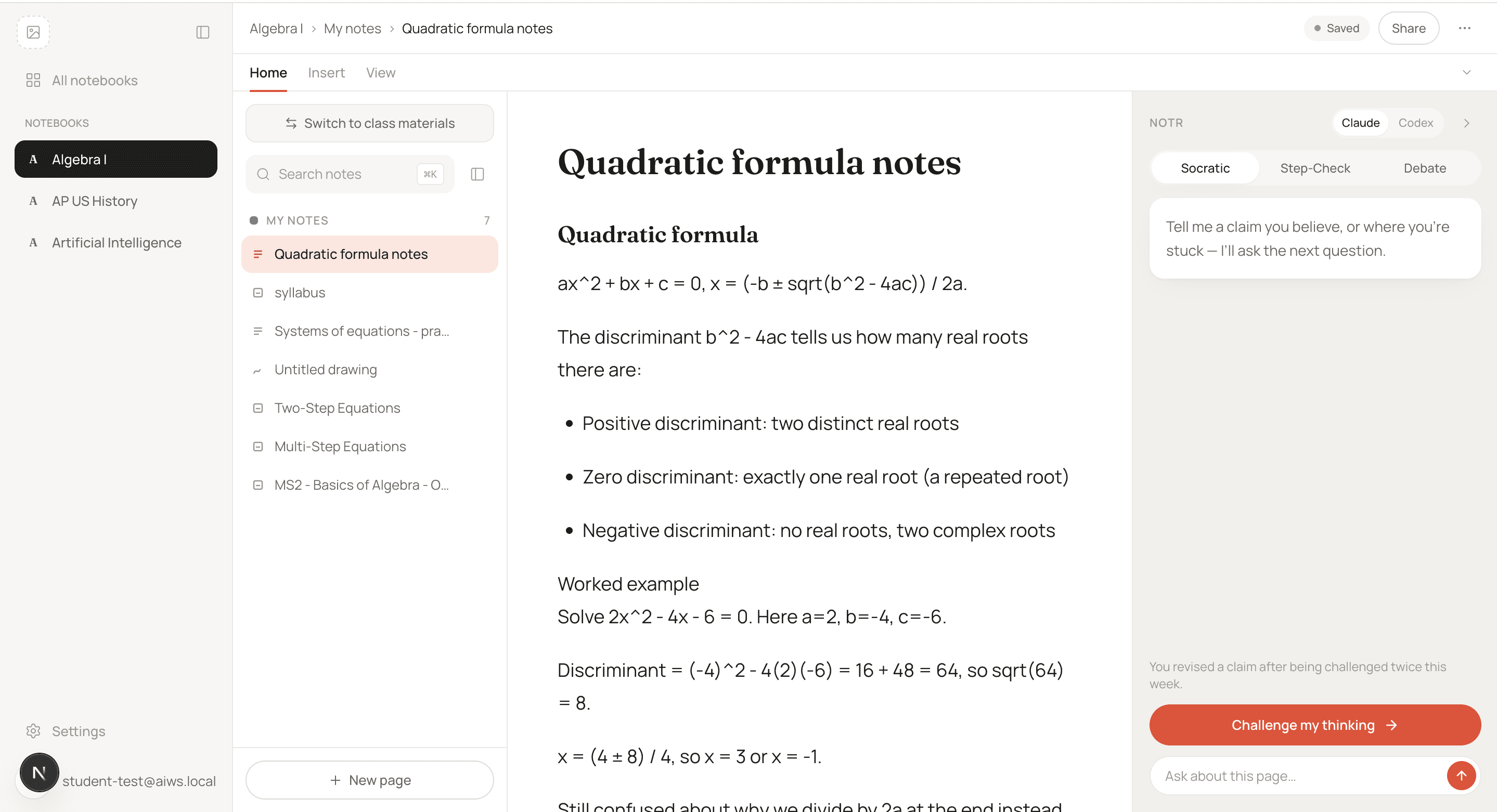
Notebox: an AI learning workspace that builds assigments, learning, and lessons around the thinking process of students, rather than just the right answer.
The product
Built around how students actually think
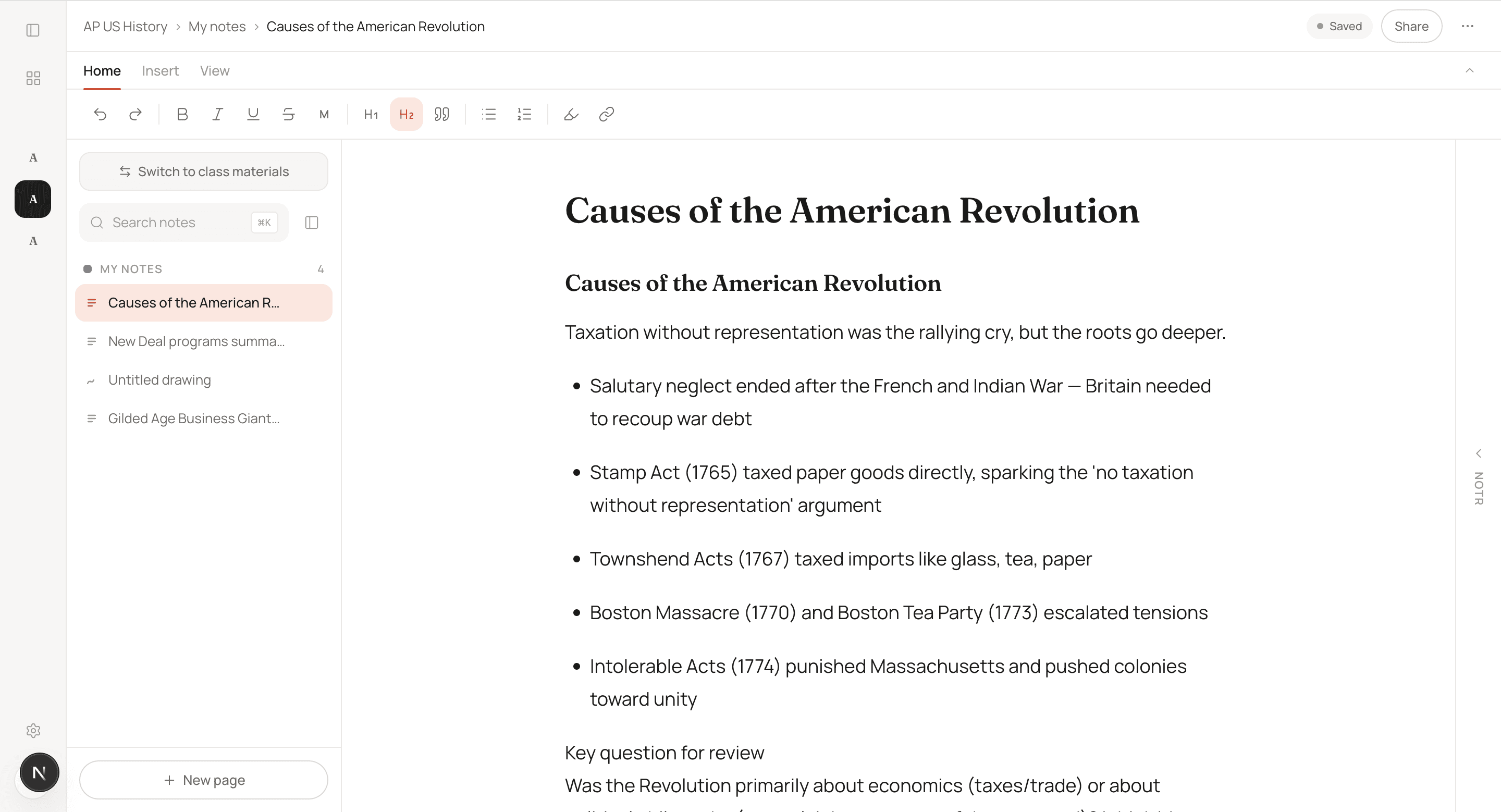
Notebook
A structured workspace where students take notes, think through class materials, and interact with their instructors.
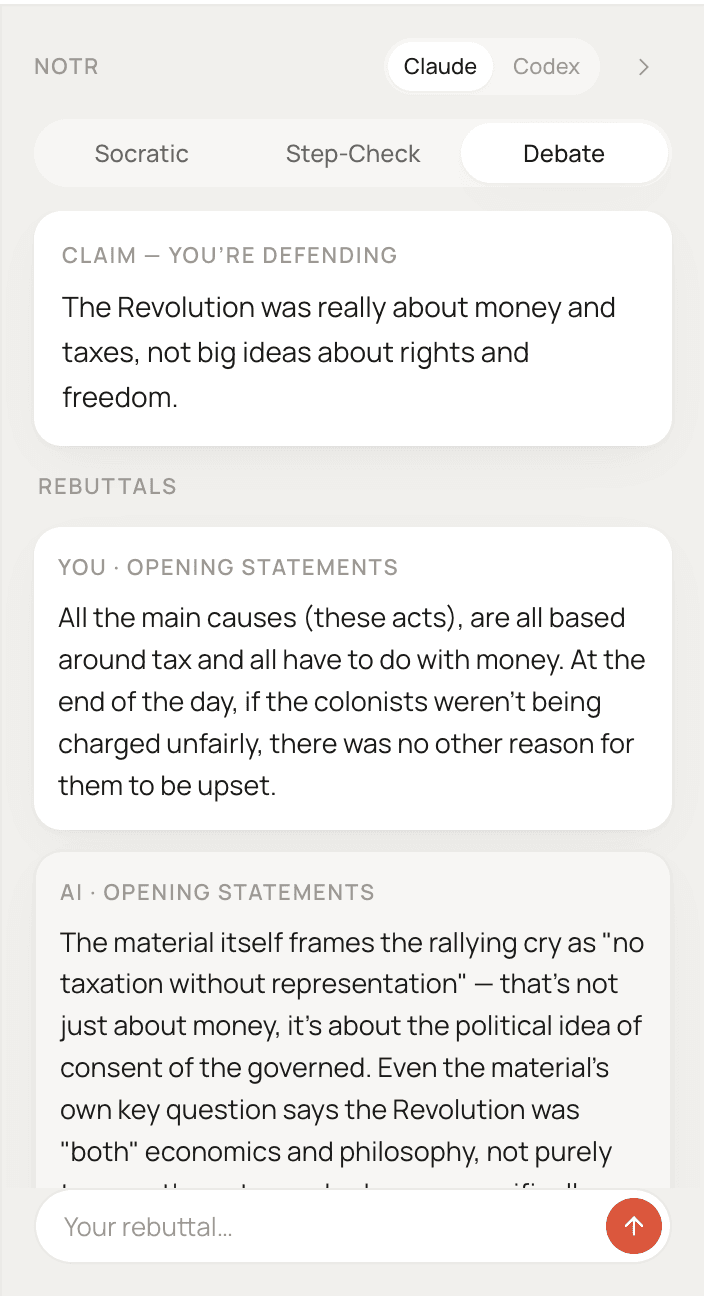
NOTR AI sidebar
Our AI agent configured specifically for use cases: Socratic asks the next question, Step-Check surfaces gaps in reasoning, and Debate pushes students to defend their claims. It NEVER gives the student the answer, always encourages them to keep thinking.
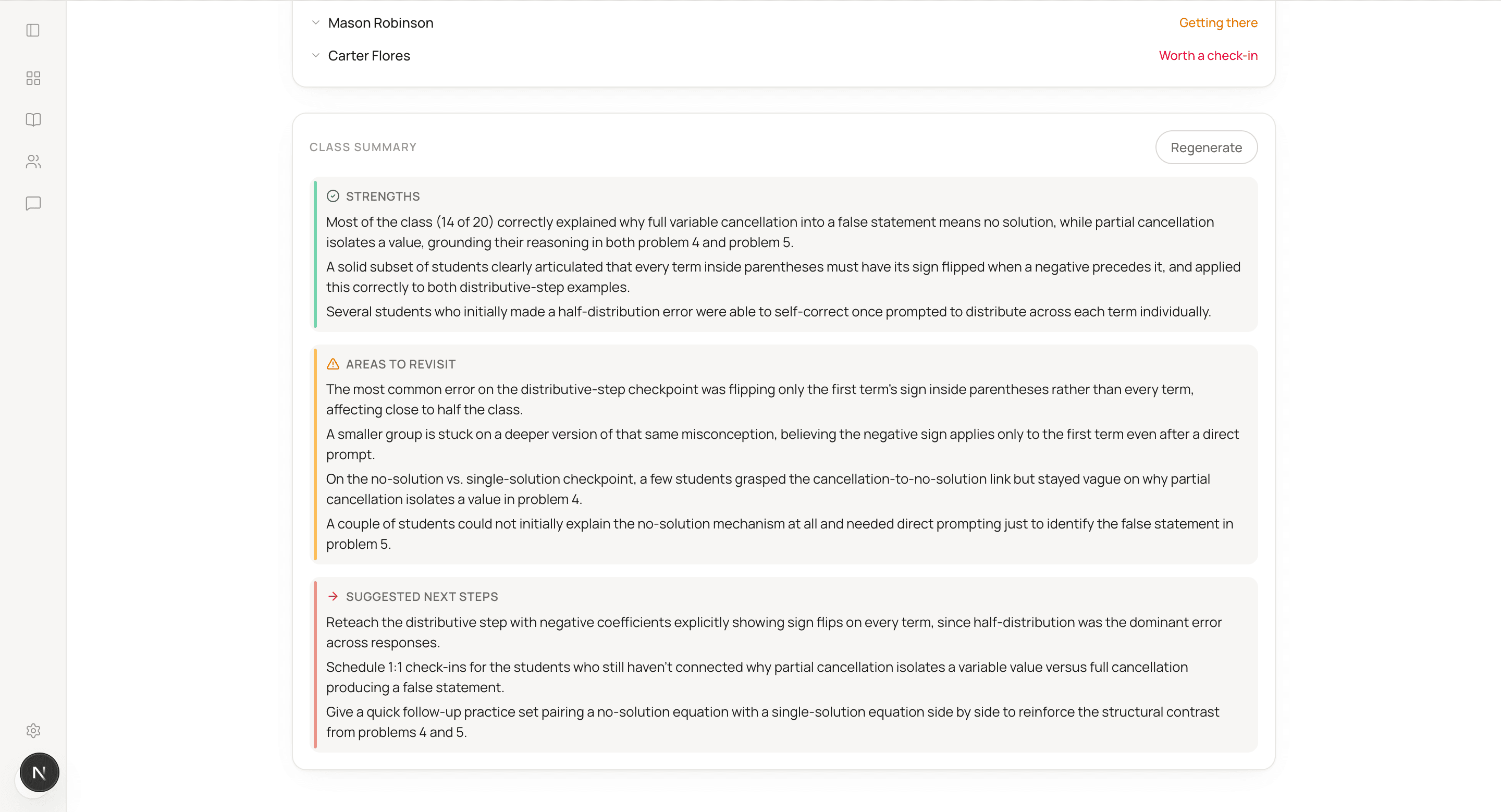
In-class thinking checks
Live class-prompts that ask students to think through related issues, rather than a multiple choice question students can guess on or cheat on. Gives teachers real signal on understanding, not just completion.
What's next
Preparing for the demo
The Notebox demo was originally scheduled for late August, but was pushed back.
We're currently heads-down preparing — refining the core flows, tightening the NOTR interaction model, and making sure the in-class thinking checks hold up in a real classroom setting.
The demo is upcoming. More to come.